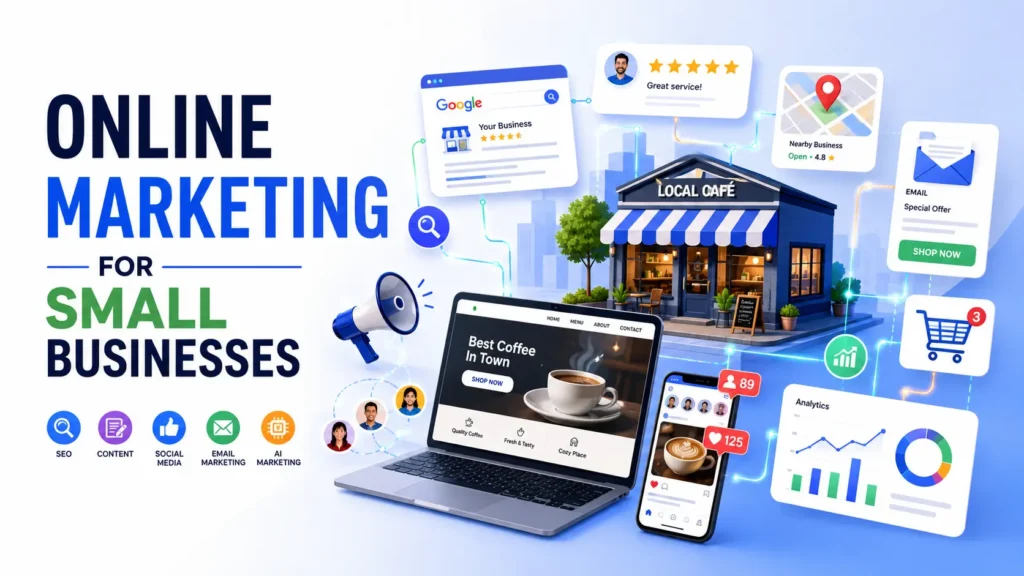
Running a small business today means competing in a highly competitive environment where attention is constantly being fought for.
Every scroll, search, and swipe captures just a few seconds of someone’s focus.However, the good news is that online marketing has become more accessible and affordable for small business owners than ever before.You don’t need a large budget to compete with bigger companies.What you do need is a clear plan, consistency, and a willingness to try what works best for your audience.
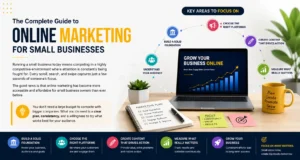 This guide outlines the key areas of online marketing that small businesses should focus on: building a solid foundation, selecting the right platforms, creating content that drives action, and measuring what really matters — all without complex jargon or unnecessary information.
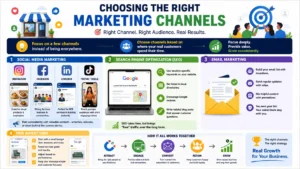
 Choosing the Right Marketing Channels
One of the biggest mistakes small business owners make is trying to be active on every platform at once.
It’s far better to focus on a few channels thoroughly rather than spreading yourself too thin across several platforms with incomplete profiles. Choose channels based on where your real customers spend their time.
Social Media Marketing
Social media is often the best starting point for online marketing for small business owners because it’s free to use and directly connects you with your audience.
– Instagram works well for visually appealing products — such as food, fashion, handmade goods, beauty, and home decor.
– Facebook remains strong for local businesses and community-focused audiences, especially through Facebook Groups and local marketplace features.
– LinkedIn is a great choice if you sell B2B services or want to build authority in a professional field.
– TikTok and Instagram Reels are increasingly important for reaching younger audiences and gaining organic reach through short, engaging videos.
The key to social media isn’t posting constantly — it’s posting consistently with content that adds value.
Whether that’s entertainment, education, or behind-the-scenes storytelling, your audience connects with businesses that feel genuine and human.
Search Engine Optimization (SEO)
SEO is the process of improving your website so it ranks higher in search results when people look for what you offer.
It’s not a quick fix, but it brings in “free” traffic over time.
For small businesses, local SEO can be especially valuable:
– Use location-specific keywords naturally in your website content (e.g., “custom furniture in Kozhikode” instead of just “custom furniture”)
– Get listed in local directories and niche-specific listing sites
– Encourage happy customers to leave Google reviews — reviews are a major factor in local search rankings
– Write blog posts that answer real questions your customers might have, such as “how to choose the right [product]” or “what to look for when hiring a [service]”
Choosing the Right Marketing Channels
One of the biggest mistakes small business owners make is trying to be active on every platform at once.
It’s far better to focus on a few channels thoroughly rather than spreading yourself too thin across several platforms with incomplete profiles. Choose channels based on where your real customers spend their time.
Social Media Marketing
Social media is often the best starting point for online marketing for small business owners because it’s free to use and directly connects you with your audience.
– Instagram works well for visually appealing products — such as food, fashion, handmade goods, beauty, and home decor.
– Facebook remains strong for local businesses and community-focused audiences, especially through Facebook Groups and local marketplace features.
– LinkedIn is a great choice if you sell B2B services or want to build authority in a professional field.
– TikTok and Instagram Reels are increasingly important for reaching younger audiences and gaining organic reach through short, engaging videos.
The key to social media isn’t posting constantly — it’s posting consistently with content that adds value.
Whether that’s entertainment, education, or behind-the-scenes storytelling, your audience connects with businesses that feel genuine and human.
Search Engine Optimization (SEO)
SEO is the process of improving your website so it ranks higher in search results when people look for what you offer.
It’s not a quick fix, but it brings in “free” traffic over time.
For small businesses, local SEO can be especially valuable:
– Use location-specific keywords naturally in your website content (e.g., “custom furniture in Kozhikode” instead of just “custom furniture”)
– Get listed in local directories and niche-specific listing sites
– Encourage happy customers to leave Google reviews — reviews are a major factor in local search rankings
– Write blog posts that answer real questions your customers might have, such as “how to choose the right [product]” or “what to look for when hiring a [service]”
 Email Marketing
Email is often undervalued by small businesses, but it remains one of the highest return-on-investment channels in online marketing for small business growth.
Unlike social media, you completely own your email list — even if a platform changes its algorithm, your subscribers stay with you.
Start simple: collect emails through your website or in-store with a small incentive (like a discount, a free guide, or early access to new products), then send regular updates that mix promotional messages with valuable content.
Avoid only emailing when you want to sell something — a newsletter that provides consistent value will also drive sales when you do promote a product or service.
Paid Advertising
Once your organic foundation is solid, paid advertising can help you grow faster. This is usually the final layer of a well-rounded online marketing for small business strategy, not the starting point.
Platforms like Meta Ads (Facebook/Instagram) and Google Ads allow small businesses to target specific audiences with manageable budgets — you don’t need a large budget to start testing.
A few key principles for small-budget advertising:
– Start with a small test budget and only scale up if results are good
– Focus on clear goals and measurable outcomes
– Be ready to adjust strategies based on performance
– Keep your messaging simple and focused on what matters most to your audience.
Creating Content That Actually Converts
Good content marketing isn’t about producing more content — it’s about producing content that moves someone closer to a purchase decision. A big part of doing online marketing for small business growth well comes down to three types of content that tend to perform especially well:
– Educational content — how-to guides, tips, and explainers that position you as knowledgeable and trustworthy in your niche.
– Social proof — testimonials, before-and-after photos, customer stories, and user-generated content. People trust other people far more than they trust brand messaging.
– Behind-the-scenes content — showing how products are made, introducing team members, or sharing the story behind the business. This humanizes your brand and builds emotional connection.
Whatever you create, always include a clear next step: visit the website, message us, use this code, book a call. Content without a call to action is just entertainment — content with one is marketing.
Measuring What Matters
It’s easy to get distracted by vanity metrics like follower counts or likes, but those numbers don’t pay the bills. Any good online marketing for small business plan needs to focus instead on metrics tied to actual business outcomes:
– Website traffic and traffic sources — where are visitors coming from, and which sources bring the most engaged users?
– Conversion rate — what percentage of visitors take a meaningful action (purchase, inquiry, booking)?
– Customer acquisition cost — how much are you spending, across all channels, to gain one paying customer?
– Email open and click rates — a strong indicator of how engaged your list actually is.
Free tools like Google Analytics and the built-in insights on social platforms provide plenty of data to start with — you don’t need expensive software to make informed decisions early on.
Common Mistakes to Avoid
– Inconsistency — posting heavily for two weeks and then disappearing for a month undermines trust and algorithm visibility alike.
– Selling too hard, too often — audiences tune out accounts that only ever ask for money. Aim for a mix where most content provides value and only some content sells directly.
– Ignoring reviews and messages — slow or absent responses signal a business that doesn’t care, and customers notice.
– Trying every channel at once — better to master two or three channels than to be mediocre across six.
– Copying competitors instead of understanding your own audience — what works for one business may not translate to another, even within the same industry. The best approach to online marketing for small business owners is one built around your specific customers, not a generic template borrowed from someone else’s playbook.
Bringing It All Together
Online marketing for small business owners doesn’t require a massive budget or a marketing degree — it requires clarity about who your customer is, consistency in showing up for them, and a willingness to learn from what the data tells you.
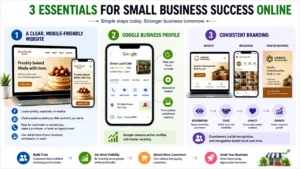
Start with a solid foundation: a clear website and an optimized Google Business Profile. Choose one or two channels where your customers actually spend time, and commit to showing up there regularly with content that genuinely helps or entertains. Layer in email marketing early, since it compounds in value over time, and once you have some traction, use small paid ad budgets to accelerate what’s already working.
The businesses that win at online marketing for small business growth aren’t necessarily the ones with the biggest budgets — they’re the ones that stay consistent, listen to their audience, and keep refining their approach based on real results.
If you’d like hands-on help building out any of these strategies for your own business, take a look at my digital marketing services or get in touch and we can put together a plan that fits your goals.
Email Marketing
Email is often undervalued by small businesses, but it remains one of the highest return-on-investment channels in online marketing for small business growth.
Unlike social media, you completely own your email list — even if a platform changes its algorithm, your subscribers stay with you.
Start simple: collect emails through your website or in-store with a small incentive (like a discount, a free guide, or early access to new products), then send regular updates that mix promotional messages with valuable content.
Avoid only emailing when you want to sell something — a newsletter that provides consistent value will also drive sales when you do promote a product or service.
Paid Advertising
Once your organic foundation is solid, paid advertising can help you grow faster. This is usually the final layer of a well-rounded online marketing for small business strategy, not the starting point.
Platforms like Meta Ads (Facebook/Instagram) and Google Ads allow small businesses to target specific audiences with manageable budgets — you don’t need a large budget to start testing.
A few key principles for small-budget advertising:
– Start with a small test budget and only scale up if results are good
– Focus on clear goals and measurable outcomes
– Be ready to adjust strategies based on performance
– Keep your messaging simple and focused on what matters most to your audience.
Creating Content That Actually Converts
Good content marketing isn’t about producing more content — it’s about producing content that moves someone closer to a purchase decision. A big part of doing online marketing for small business growth well comes down to three types of content that tend to perform especially well:
– Educational content — how-to guides, tips, and explainers that position you as knowledgeable and trustworthy in your niche.
– Social proof — testimonials, before-and-after photos, customer stories, and user-generated content. People trust other people far more than they trust brand messaging.
– Behind-the-scenes content — showing how products are made, introducing team members, or sharing the story behind the business. This humanizes your brand and builds emotional connection.
Whatever you create, always include a clear next step: visit the website, message us, use this code, book a call. Content without a call to action is just entertainment — content with one is marketing.
Measuring What Matters
It’s easy to get distracted by vanity metrics like follower counts or likes, but those numbers don’t pay the bills. Any good online marketing for small business plan needs to focus instead on metrics tied to actual business outcomes:
– Website traffic and traffic sources — where are visitors coming from, and which sources bring the most engaged users?
– Conversion rate — what percentage of visitors take a meaningful action (purchase, inquiry, booking)?
– Customer acquisition cost — how much are you spending, across all channels, to gain one paying customer?
– Email open and click rates — a strong indicator of how engaged your list actually is.
Free tools like Google Analytics and the built-in insights on social platforms provide plenty of data to start with — you don’t need expensive software to make informed decisions early on.
Common Mistakes to Avoid
– Inconsistency — posting heavily for two weeks and then disappearing for a month undermines trust and algorithm visibility alike.
– Selling too hard, too often — audiences tune out accounts that only ever ask for money. Aim for a mix where most content provides value and only some content sells directly.
– Ignoring reviews and messages — slow or absent responses signal a business that doesn’t care, and customers notice.
– Trying every channel at once — better to master two or three channels than to be mediocre across six.
– Copying competitors instead of understanding your own audience — what works for one business may not translate to another, even within the same industry. The best approach to online marketing for small business owners is one built around your specific customers, not a generic template borrowed from someone else’s playbook.
Bringing It All Together
Online marketing for small business owners doesn’t require a massive budget or a marketing degree — it requires clarity about who your customer is, consistency in showing up for them, and a willingness to learn from what the data tells you.
Start with a solid foundation: a clear website and an optimized Google Business Profile. Choose one or two channels where your customers actually spend time, and commit to showing up there regularly with content that genuinely helps or entertains. Layer in email marketing early, since it compounds in value over time, and once you have some traction, use small paid ad budgets to accelerate what’s already working.
The businesses that win at online marketing for small business growth aren’t necessarily the ones with the biggest budgets — they’re the ones that stay consistent, listen to their audience, and keep refining their approach based on real results.
If you’d like hands-on help building out any of these strategies for your own business, take a look at my digital marketing services or get in touch and we can put together a plan that fits your goals.