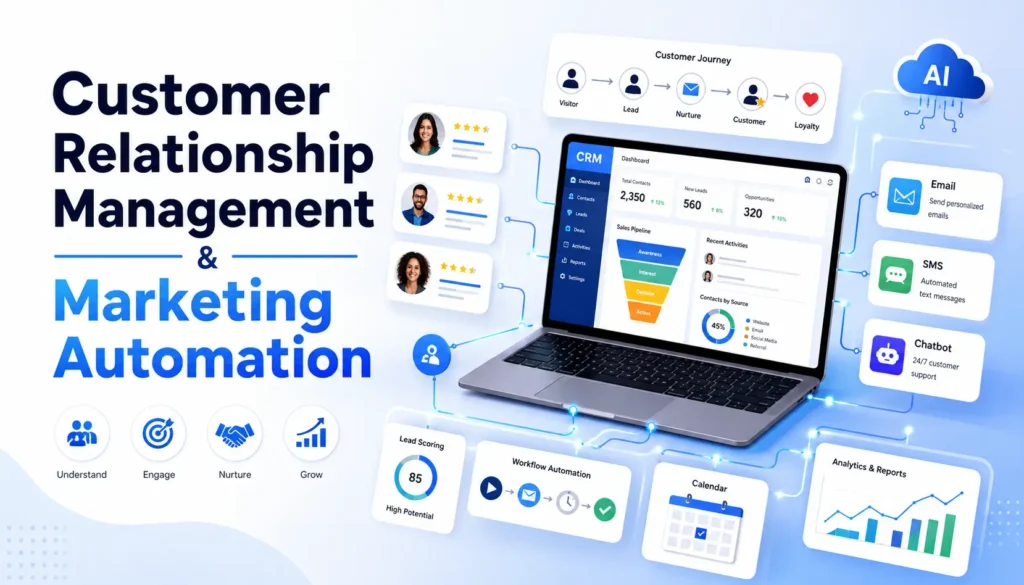
Every business no matter how small it is is actually in the business of building relationships with people. Every sale starts with someone who does not know you moves through a series of interactions and if things go well ends with a customer who buys from you again and tells others about you. The problem is that once a business grows past a customer it becomes really hard to keep track of who someone is, what they have bought, what they are interested in and when to follow up with them. You just cannot manage all this information from memory or a messy spreadsheet.
This is where a Customer Relationship Management system comes in and when it is paired with marketing automation it becomes a powerful tool for a business to grow efficiently. This post breaks down what Customer Relationship Management and marketing automation actually look like together, how the two work in tandem and how to use them in a way that works for you even if you are running a small business.
What Is a Customer Relationship Management System Really?
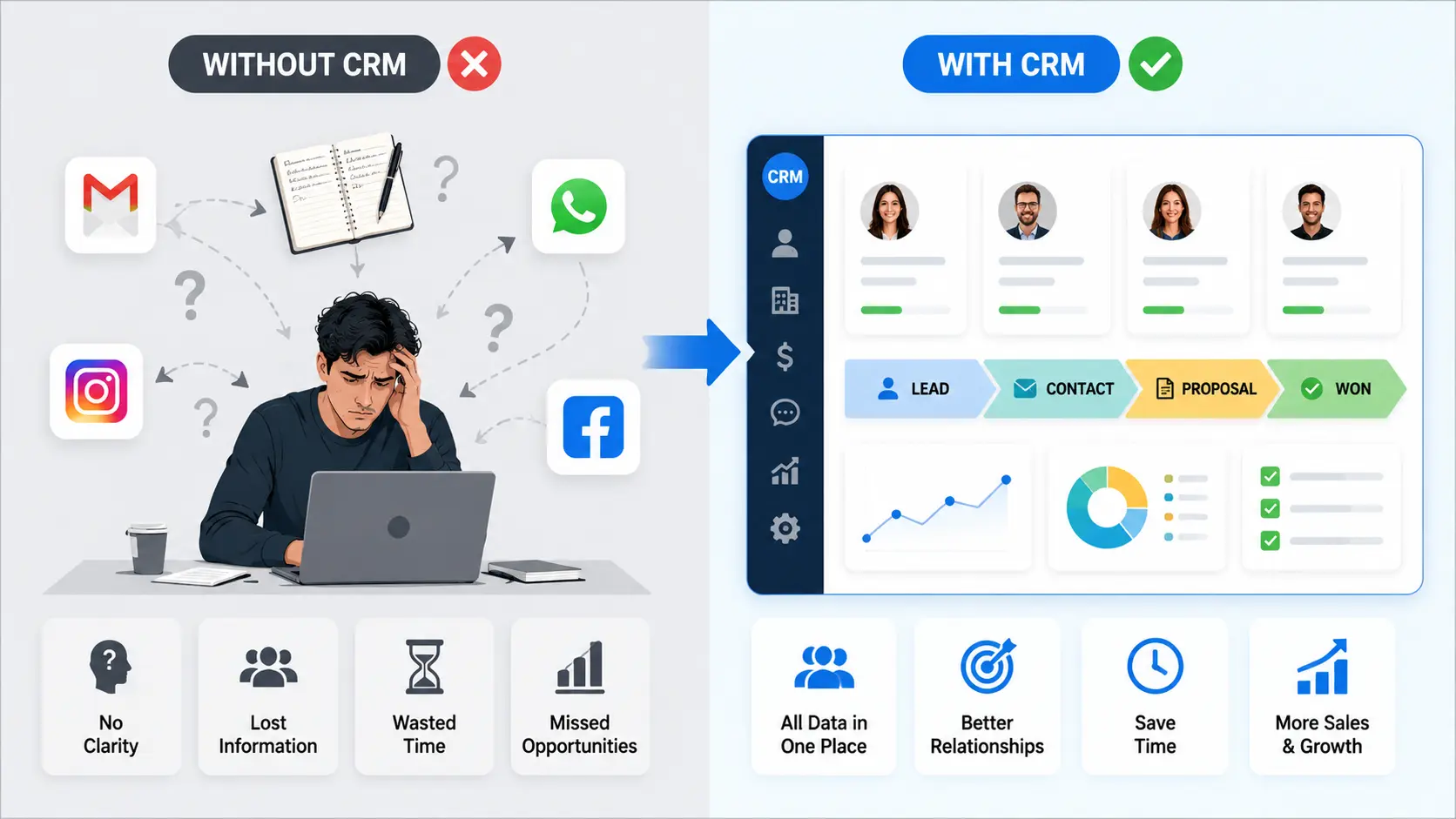
At its core a Customer Relationship Management system is a tool that stores and organizes information about every person your business interacts with including people who might buy from you and existing customers. By having contact information all over the place in email inboxes, notebooks and social media messages a Customer Relationship Management system brings everything into one place: names, contact information, what people have bought, past conversations, preferences and where each person is in their journey with your business.
A good Customer Relationship Management system answers questions like:
– Who has shown interest in our product but has not bought it yet?
– Which customers have not bought anything from us in the three months?
– What did this specific customer ask about the time they messaged us?
– Which people came from Instagram versus our website versus a referral?
Without a Customer Relationship Management system this information is in someone’s head or is lost when that person forgets or leaves the business. With a Customer Relationship Management system it becomes a record that the whole team can rely on. If you want a deeper technical breakdown of how these systems are built, Salesforce’s guide to what CRM is is a solid reference.
What Is Marketing Automation?
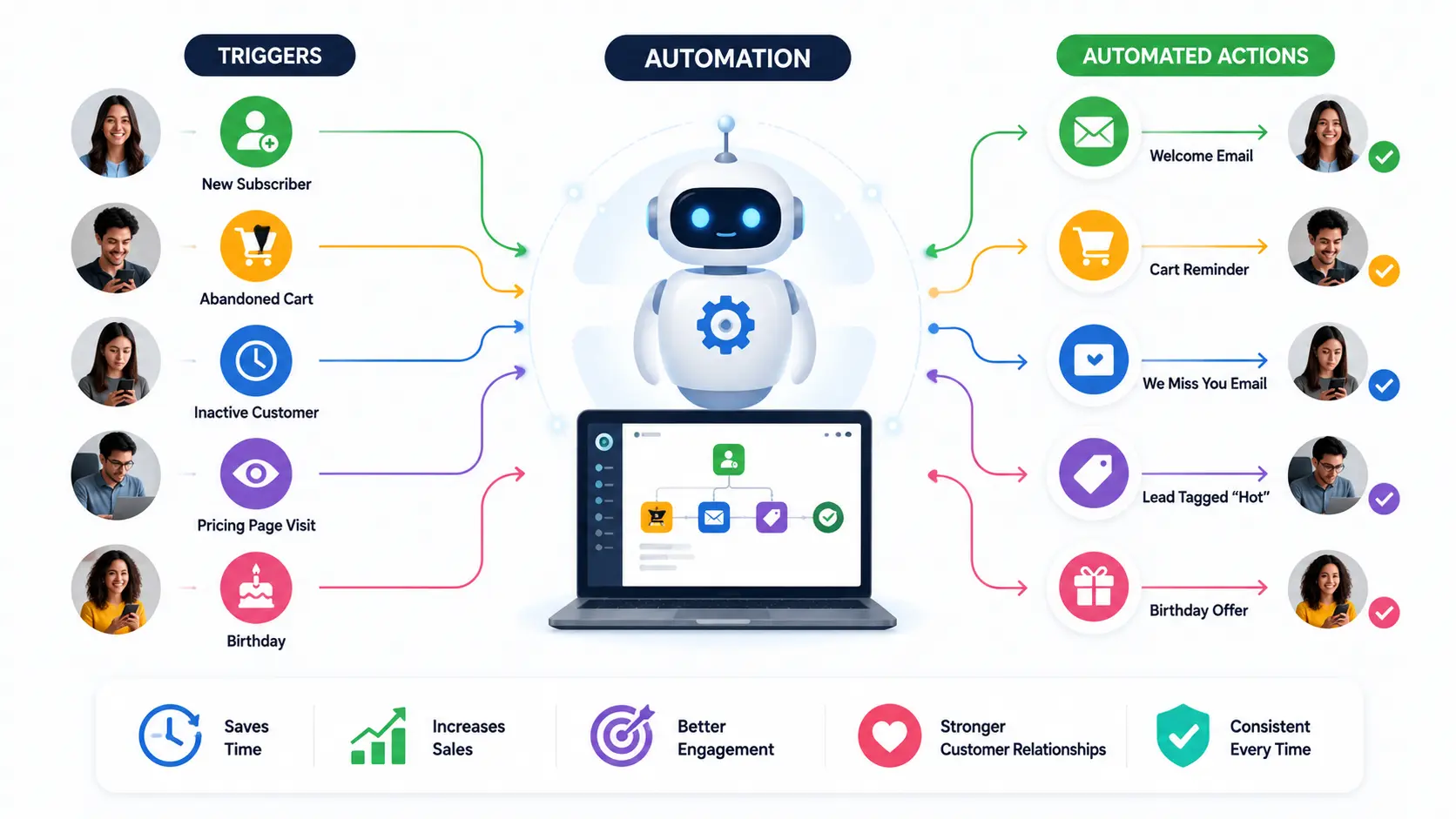
Marketing automation refers to software that does marketing tasks automatically based on rules you set up in advance rather than having a person do it manually. By remembering to email every new subscriber, follow up with every abandoned cart or check in with customers who have not bought in a while automation handles it in the background consistently and at scale.
Some common examples of marketing automation include:
– Sending an email automatically when someone joins your mailing list
– Sending a reminder when a customer leaves items in their cart without completing checkout
– Sending a “we miss you” message to customers who have not engaged in sixty or ninety days
– Automatically tagging a lead as “hot” when they visit your pricing page multiple times
– Sending a birthday discount code on a customers birthday pulled automatically from their profile
The key benefit is that it is consistent. A human following up with hundreds of leads will inevitably miss some. Lose track of timing. Automation never forgets, never gets tired and treats every customer with the level of care.
Why Customer Relationship Management and Marketing Automation Work Better Together?
Customer Relationship Management and marketing automation are often sold as tools but they are most powerful when combined, either through a platform that offers both or through integrated systems that share data seamlessly. Here’s why the combination matters much:
The Customer Relationship Management system provides the data. Automation acts on it. A Customer Relationship Management system knows that a customer bought a product three months ago and has not returned since. Marketing automation can use that piece of information to automatically send a personalized re-engagement offer without anyone having to manually pull a list and write an email.
Automation feeds information back into the Customer Relationship Management system. When automation sends a campaign and tracks who opened it, clicked a link or made a purchase that behavior gets recorded back into the Customer Relationship Management system. Over time this builds a picture of each customer what they respond to, what they ignore and what stage of the buying journey they are in.
Together they enable personalization at scale. Sending the generic email to everyone on your list performs far worse than sending relevant messages based on each person’s actual behavior and history. A well-combined Customer Relationship Management and marketing automation setup makes this level of personalization possible without requiring a large team to manage it manually.
Core Components of a Customer Relationship Management System with Marketing Automation
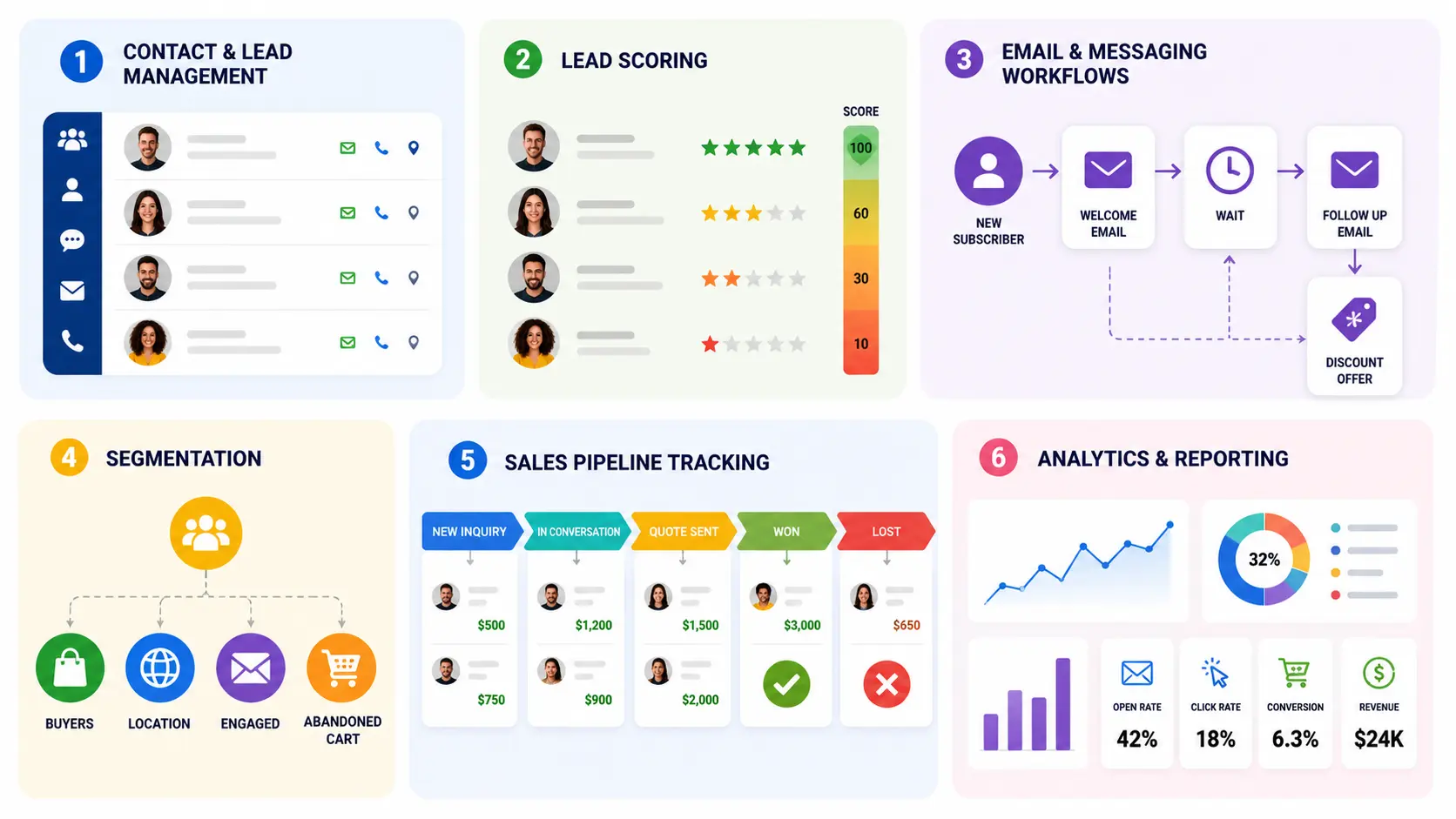
- Contact and Lead Management
This is the foundation, a database of everyone who has interacted with your business along with relevant details: how they found you, what they have purchased, what stage they are at and any notes from past conversations.
- Lead Scoring
Lead scoring assigns points to prospects based on their behavior and characteristics for example opening emails visiting your website times or downloading a resource. This allows a business to focus its energy on the leads likely to convert, rather than treating every contact identically.
- Email and Messaging Workflows
This is where much of marketing automation lives, built sequences of emails or messages triggered by specific actions. A new subscriber might automatically receive a series over the first week while someone who abandons a cart might receive a reminder a few hours later followed by a discount offer if they still have not purchased.
- Segmentation
Segmentation is the practice of dividing your contact list into groups based on shared characteristics, purchase history, location, engagement level or interests. Then sending one email to your entire list segmentation allows you to send more relevant content to each group, which significantly improves engagement and conversion rates.
- Sales Pipeline Tracking
Many Customer Relationship Management systems include a pipeline that shows exactly where each lead or deal stands new inquiry in conversation quote sent, closed won, closed lost. This gives business owners a real-time view of revenue in progress rather than relying on memory or guesswork.
- Analytics and Reporting
A Customer Relationship Management system with automation should tell you what is working. Open rates, click-through rates, conversion rates by campaign and revenue attributed to automated workflows all help refine your strategy over time rather than relying on intuition alone.
Practical Ways Small Businesses Can Use Customer Relationship Management and Automation
You do not need a big budget to benefit from these tools. Many platforms designed for small businesses offer Customer Relationship Management and marketing automation features at accessible price points and some even offer free tiers for businesses just starting out. A few practical starting points:
Welcome sequences — When someone signs up for your newsletter or makes their purchase an automated series introducing your brand’s best-selling products or story can build trust without any manual effort.
Abandoned cart recovery – For e-commerce businesses this is often one of the highest-return automations. A simple reminder email can recover a meaningful percentage of otherwise lost sales.
Re-engagement campaigns — Automatically identifying customers who have not purchased in a period and sending them a tailored offer keeps your existing customer base active instead of letting it quietly fade.
Post-purchase follow-ups — Automatically thanking customers asking for reviews or suggesting products after a purchase increases both satisfaction and repeat sales.
Lead nurturing for sales cycles — For service-based businesses where a decision takes time automated follow-up sequences keep your business top of mind without requiring manual outreach.
Choosing the Right Tool
There are Customer Relationship Management and marketing automation platforms suited to every business size and budget ranging from simple affordable tools built for solo entrepreneurs and small teams to comprehensive enterprise platforms with extensive customization. When evaluating options small business owners should generally prioritize:
Ease of use — a powerful system that is too complicated to use consistently provides little value.
Integration with existing tools — the Customer Relationship Management system should connect smoothly with your website, e-commerce platform and email or messaging channels.
Scalability — a good starting platform should be able to grow with the business rather than requiring a disruptive switch later.
Cost relative to features actually needed — it is easy to overpay for advanced features that a small business will not use for years if ever.
Avoiding Common Pitfalls
Over-automating and losing the human touch — Automation should support relationships not replace them entirely. Important conversations, complaints or high-value customers often still deserve a human response.
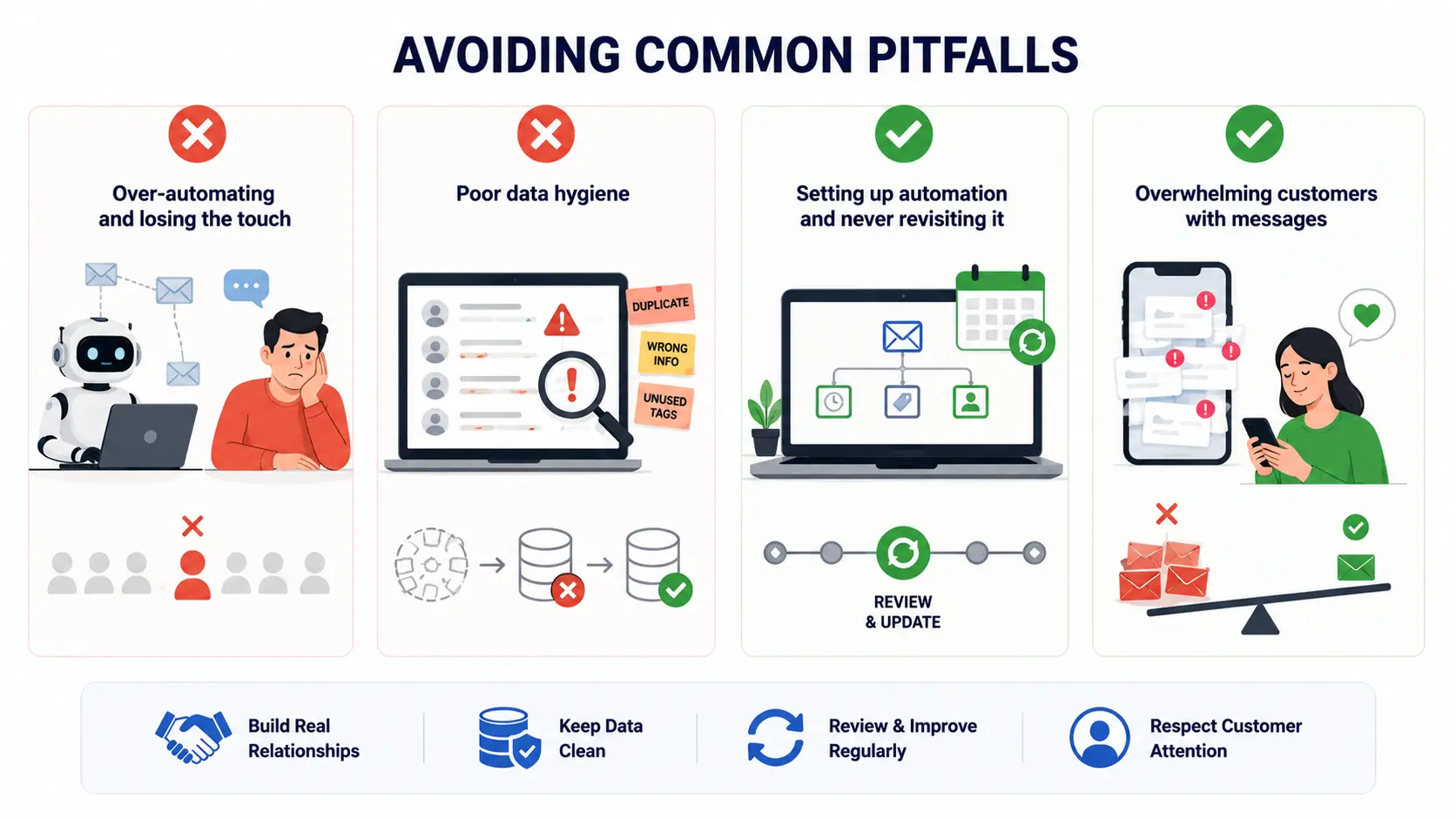
Poor data hygiene — A Customer Relationship Management system is only as useful as the data inside it. Duplicate contacts, information and inconsistent tagging quietly undermine the value of even the best system.
Setting up automation and never revisiting it — Customer behavior and business needs change over time. Automated workflows should be reviewed periodically to ensure they still reflect products, pricing and messaging.
Overwhelming customers with messages — Just because automation makes it easy to send messages does not mean it is wise to do so. Respecting customer attention builds long-term trust better than constant promotional contact.
Bringing It All Together
A well set up Customer Relationship Management system paired with marketing automation transforms scattered, easily forgotten customer information into a structured system that actively works to grow the business, nurturing leads, recovering lost sales and deepening relationships with existing customers, all with far less manual effort than doing it by hand. For a small business this does not mean adopting complex enterprise software on day one. It means starting with a well-organized system, automating a handful of high-impact workflows like welcome sequences and abandoned cart recovery, and expanding from there as the business grows.
The businesses that use these tools well are not the ones with the most complicated setup. They are the ones that use their customer data consistently and personalize things thoughtfully, remembering that there is a real person behind every contact who is deciding whether to trust the business again.
If you’re a small business owner looking to set up Customer Relationship Management and marketing automation the right way, feel free to explore my digital marketing services or get in touch and we can figure out the right approach for your business together.